
Artificial intelligence is rapidly evolving from a passive assistant into an active participant in the economy. Today, AI systems summarize documents, answer questions, generate code, and automate workflows. The next phase is much larger: AI agents that can independently complete tasks on behalf of users and businesses. That future creates a major infrastructure challenge.
What is an AI Agent?
An AI agent is a software system that can autonomously make decisions, take actions, interact with APIs, and complete tasks on behalf of a user or business. Unlike traditional software, AI agents can reason through workflows dynamically, including researching information, coordinating systems, and eventually initiating financial transactions.
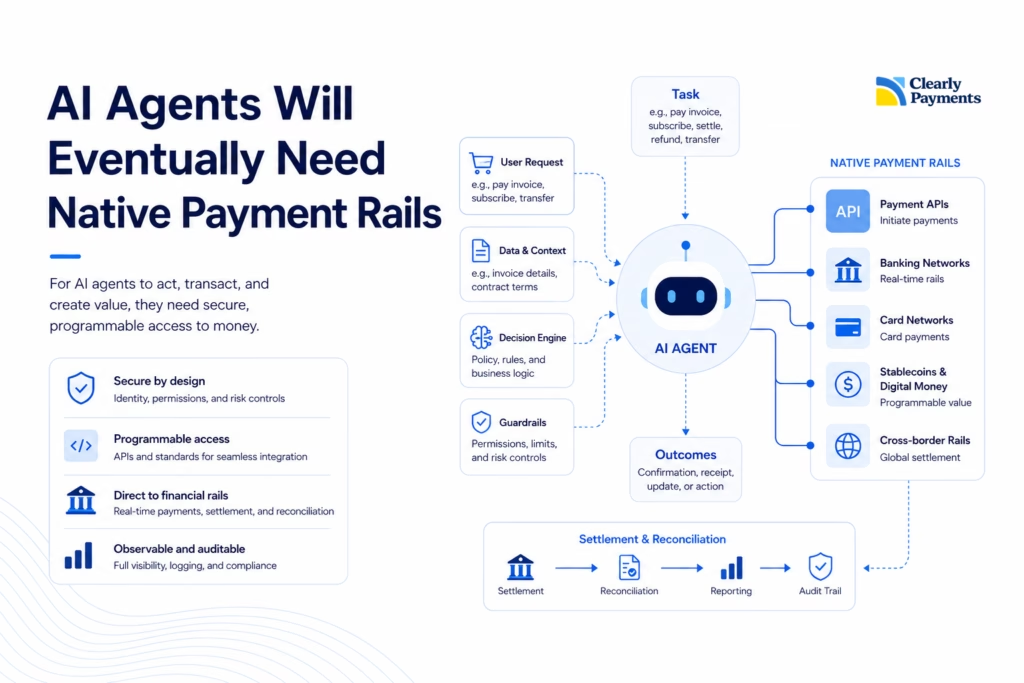
If AI agents are going to book travel, pay suppliers, optimize software spending, replenish inventory, negotiate services, or manage operational workflows, they will eventually need native access to payment systems. Existing payment infrastructure was built for humans interacting through websites and apps, not autonomous software agents operating continuously at machine speed.
The companies building the next generation of payment rails may ultimately become foundational infrastructure for the AI economy.
AI Is Moving Beyond Information Into Commerce
Most AI systems today still operate with a human in the loop. A user asks a question, reviews the output, and manually approves the next step.
That model does not scale particularly well.
Over time, businesses will increasingly deploy AI agents that manage workflows continuously in the background. An agent may monitor cloud infrastructure costs, optimize advertising spend, renew subscriptions, reorder inventory, coordinate logistics, or negotiate vendor pricing automatically. At scale, these systems begin acting less like software tools and more like autonomous economic participants.
The internet already experienced a similar evolution. Early websites were static. Then applications became interactive. APIs eventually allowed software systems to communicate directly with each other at scale.
Payments appear to be heading toward a similar transition.
Existing Payment Infrastructure Was Designed Around Humans
| Traditional Payments | AI Agent Commerce |
|---|---|
| Human checkout flows | API-to-API transactions |
| Manual approvals | Autonomous execution |
| Static merchant relationships | Dynamic vendor selection |
| Human authentication | Machine identity systems |
| Business hours | Continuous 24/7 operation |
| Human fraud review | Real-time automated risk systems |
AI Agents Will Need Machine-Native Identity
Payments are fundamentally tied to trust and identity. Humans use passports, signatures, biometrics, passwords, and legal entities to prove authorization.
AI agents will eventually require their own trust framework.
An enterprise may authorize an AI procurement agent to:
- spend up to a certain monthly limit
- purchase only from approved vendors
- require human escalation above defined thresholds
- optimize for lowest total cost
- comply with geographic or regulatory restrictions
That begins to resemble programmable finance rather than traditional payments. The future payment stack for AI systems may include:
- cryptographic identity
- delegated spending authority
- programmable permissions
- machine-readable compliance
- dynamic transaction controls
- verifiable audit trails
- real-time authorization systems
These capabilities are difficult to layer cleanly onto infrastructure originally designed for human-operated card transactions.
Why Stablecoins and Programmable Money Keep Appearing in AI Discussions
One reason stablecoins continue gaining attention is that they are inherently programmable and API-native.
Traditional banking systems were not originally designed for software-driven global commerce operating continuously in real time. Stablecoin infrastructure, by contrast, was largely built around interoperability, programmability, and direct system integration.
That does not mean banks or card networks disappear. Existing financial infrastructure remains deeply entrenched and highly valuable. More likely, the financial system gradually evolves into a hybrid model where traditional institutions integrate more programmable settlement layers underneath modern applications.
Several characteristics make programmable payment infrastructure particularly attractive for AI-driven commerce:
| Traditional Banking Infrastructure | Programmable Payment Infrastructure |
|---|---|
| Limited operating hours | Continuous availability |
| Multiple intermediaries | Direct programmable transfers |
| Manual reconciliation | Machine-readable transactions |
| Slower settlement cycles | Near real-time settlement |
| Human-centric workflows | API-native integrations |
This is one reason major financial institutions, fintech companies, and payment processors are increasingly exploring:
- stablecoin settlement
- tokenized deposits
- embedded finance
- programmable treasury systems
- real-time payment networks
- API-native financial infrastructure
The opportunity is not just faster payments. It is enabling autonomous economic systems.
Fraud and Risk Become Much More Complex
AI-driven commerce introduces entirely new categories of fraud and risk. Bad actors will deploy AI agents as well. Future payment systems may need to defend against:
- synthetic merchant networks
- automated transaction laundering
- AI-generated identity attacks
- autonomous fraud rings
- machine-scale phishing campaigns
- coordinated agent-based abuse
The scale and speed of these systems may eventually exceed what manual review teams can realistically manage.
As a result, payment infrastructure will likely become increasingly dependent on:
- behavioral analytics
- adaptive risk engines
- cryptographic verification
- AI-powered fraud detection
- network-level intelligence
- continuous transaction monitoring
Ironically, AI may become both the attacker and the primary defense layer.
The Checkout Page May Eventually Disappear
One of the most important long-term implications is that the concept of “checkout” itself may evolve significantly.
Today, commerce is still largely designed around human interaction:
- shopping carts
- payment forms
- subscription pages
- invoices
- manual approvals
AI agents may abstract much of this away. Instead of humans manually browsing websites and comparing vendors, agents could negotiate directly with APIs, compare pricing instantly, optimize purchases continuously, and execute transactions automatically based on predefined objectives.
Commerce becomes increasingly invisible. In that world, the most important infrastructure may no longer be consumer-facing checkout experiences. Instead, value may shift toward:
- authorization frameworks
- programmable compliance systems
- machine identity infrastructure
- orchestration layers
- API-driven payment rails
- trust and verification networks
The future of payments may look less like ecommerce and more like cloud infrastructure.
Why This Matters for Payment Companies Today
Most of this transformation will not happen overnight. Financial systems move slowly, regulation matters, and trust takes years to establish.
But major technology shifts often begin gradually before accelerating quickly.
Cloud computing, SaaS, smartphones, and ecommerce all followed a similar pattern:
- early experimentation
- infrastructure buildout
- developer adoption
- enterprise adoption
- mass-market normalization
AI-driven commerce appears to be entering the infrastructure phase.
For payment companies, the strategic questions are becoming increasingly important:
- How do you authenticate AI agents?
- How do you manage delegated spending authority?
- What does KYC look like for autonomous systems?
- How do you detect machine-scale fraud?
- How do programmable permissions work?
- How do you underwrite autonomous transactions?
- What payment rails are optimized for AI-native commerce?
The companies that solve these problems could help define the next generation of financial infrastructure.