What is an effective processing rate?
Your effective processing rate is your total payment processing fees divided by your total card sales. It tells you what you are actually paying after all processing fees are included.
Think of it as the all-in cost of accepting cards, expressed as a percentage of sales. It includes the percentage charge, per-transaction charges and the other processing fees on your statement. Your quoted rate may describe only one part of that bill.
You can calculate an effective credit card processing rate for one month in a few minutes. Start with the total fees and total card sales for the same period.
How to calculate your effective rate
Add up the processing fees for the month, divide by the card sales those fees relate to, then multiply by 100.
Effective rate
Total processing fees ÷ Total card sales × 100
Worked example
$2,850 in total fees ÷ $100,000 processed × 100 = 2.85% effective rate
Use the sales figure from your processing statement, not the amount deposited into your bank account after fees. Do not mix a month’s fees with a different month’s sales. Keep both figures in the same currency; the calculation works the same way in CAD and USD.
Include percentage and per-transaction fees, monthly account charges, gateway fees and processing-related PCI or statement fees. Check for fees billed separately by your gateway or software provider. Count each fee once.
Keep the scope consistent: if you are measuring credit cards only, use credit-card fees and credit-card sales. A combined credit-and-debit figure can be useful too, but label it clearly. Keep chargeback losses and unrelated software costs separate so they do not obscure the cost of processing.
Why effective rate matters
Advertised rates do not always tell you what you actually pay. Effective rate does.
The original example is still useful. A merchant processes $10,000 and sees $195 in stated processing fees. That looks like 1.95%. But another $140 in monthly, gateway and other processing fees brings the total to $335. Divide $335 by $10,000 and the real effective rate is 3.35%.
That is why comparing two advertised percentages can lead to the wrong choice. Ask each provider to price the same transaction mix and show the total monthly cost. Then compare the effective rates. A lower headline percentage is not a saving if the extra fees wipe it out.
What is a good effective rate?
A good rate is competitive for your business’s card mix, sales channel and average transaction size. An in-person retailer and an online business accepting international rewards cards should not expect identical costs.
Use this Clearly Payments review framework to decide what to investigate. These are practical review benchmarks, not a claim that every merchant should pay the same percentage.
Quick benchmark: For many established merchants, an effective rate around 2.2%–2.8% is common. Above 2.9%, it is usually worth understanding why. Above 3.5%, I would review the pricing closely.
Your business
How to read the rate
What to do
Mostly domestic, in-person sales
Lower-cost comparison, around 2% to 2.7%
Compare against similar merchants using the same card mix. If the bill looks high, examine markup and fixed fees first.
Mostly online, rewards or international cards
Expect a higher rate, typically 2.7% to 3.5%+
Check how much of the difference comes from card costs, cross-border charges and the processor’s markup.
Small average sale or low monthly volume
Fixed fees matter more, often 2.9% or more
Convert per-transaction and monthly charges into a percentage of your sales before comparing offers.
Rate rises with no clear change in sales mix
Investigate increases of 0.20% or more
Look for new fees, higher markup or more transactions charged in expensive pricing tiers.
The useful question is: what explains my rate? A 3% effective rate on a $10 average sale means something different from 3% on a $500 average sale. Low-cost debit transactions can also pull a combined rate down. Compare like with like before deciding whether a quote is competitive.
Track two or three normal months. A one-time setup fee or an annual charge can make one month look expensive. Keep it in your total, identify it, and check the longer-term picture before switching providers.
Why your effective rate may be higher
Start with this short checklist. One or several of these can explain a rate above the percentage you expected:
- ecommerce or card-not-present transactions: online and manually entered payments can cost more than in-person payments.
- Rewards cards: premium cards can carry higher underlying card costs.
- International cards: cross-border charges can increase the total.
- Low average ticket: fixed transaction charges take a larger share of smaller sales.
- High per-transaction fees: a low percentage can hide an expensive fixed charge.
- Monthly and gateway fees: fixed charges weigh more heavily when sales are low.
- Tiered pricing: many sales may land above the advertised qualified rate.
- Expensive flat-rate pricing: simple pricing can become costly as volume grows.
Ask your processor to separate changes in the cards you accepted from changes in its own fees. A rate increase caused by more international sales needs a different response from a new monthly charge.
Flat-rate example: 2.9% + $0.30 is more than 2.9%
Suppose your price is 2.9% + $0.30 per transaction. On a $20 sale, the percentage fee is $0.58 and the transaction fee adds $0.30. The total is $0.88, or 4.40% of that sale.
On a $100 sale, the same pricing costs $3.20, or 3.20%. These examples contain only the stated transaction charges; monthly or other processing fees increase the all-in result.
The percentage did not change. The fixed fee simply takes a bigger bite out of a small sale. This is why your average ticket matters when comparing pricing models.
Interchange-plus example: see the markup separately
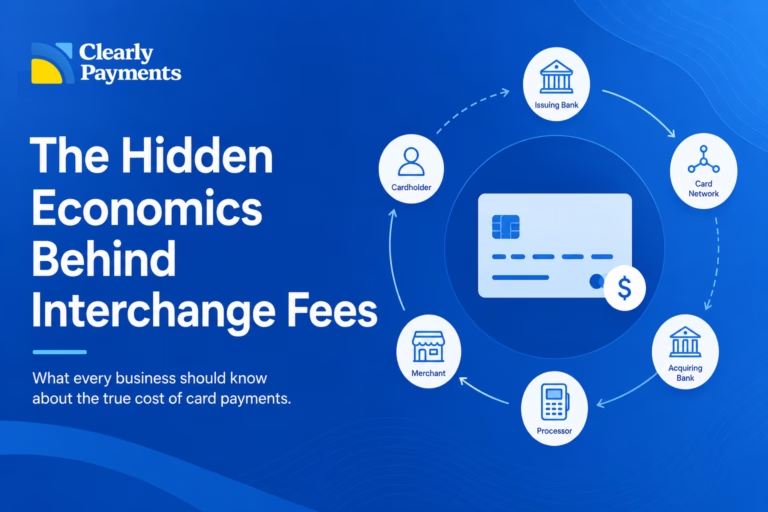
Interchange-plus separates the underlying card costs from the processor’s markup. Interchange is the part paid to the cardholder’s bank; card-network charges and the processor’s fee also contribute to the total.
For example, $2,000 in underlying card costs plus $300 in processor markup and $50 in account fees equals $2,350. On $100,000 in card sales, that produces a 2.35% effective rate. The processor’s markup alone is not your effective rate.
The advantage is visibility: you can see which part of the bill is the processor’s charge. Review Clearly Payments Cost Plus Pricing for this structure, and the Canadian or U.S. interchange rates for the underlying schedules.
Why tiered pricing makes effective rate especially important
With tiered pricing, a processor may advertise a low “qualified” rate while putting many transactions into more expensive categories. The rate that wins your attention may apply to only part of your sales.
Do not judge the offer by its lowest tier. Calculate the effective rate across the whole statement and ask how much volume fell into each category. If the provider cannot explain the difference clearly, look for a more transparent model.
How to lower your effective rate
Focus on the parts of the bill you can change. Take a recent statement and work through these five steps:
- Use the right pricing model. Compare flat-rate, interchange-plus and Membership Pricing using your actual volume and average ticket. Include all fixed fees in the comparison.
- Renegotiate processor markup. Ask for the processor’s percentage, per-transaction charge and recurring fees separately. Negotiate the total cost, not just the most visible percentage.
- Remove unnecessary fees. Review duplicate gateway charges, unused services, statement fees and avoidable non-compliance charges. Ask what each charge pays for.
- Optimize transaction qualification. Use the right checkout method and submit complete transaction details. For eligible business-card payments, ask whether enhanced transaction data can reduce underlying costs.
- Review pricing as volume grows. A convenient starter plan can become expensive at higher sales. Recalculate your effective rate regularly and request a fresh comparison.
If the statement is difficult to untangle, a payment cost analysis can separate the card costs, processor markup and extra fees. Keep the review focused on a clear monthly dollar saving.
Bottom line
Ignore the advertised rate. Calculate the effective rate. That is the number that tells you what payment processing is actually costing your business.
Use it to compare offers, question unexplained charges and track whether your pricing still fits your business. A rate you can explain is a much better starting point than a percentage in an advertisement.