
Accepting card payments in person should not force software vendors (SaaS, etc) and merchants to take on unnecessary security risk or compliance work. Semi-integrated payment terminals are designed to solve that problem. They let software vendors and merchants keep a smooth checkout experience while removing sensitive card data from their POS systems.
This article explains what semi-integrated payment terminals are, how they work, and why more merchants are choosing them over fully integrated terminals.
What Is a Semi-Integrated Payment Terminal?
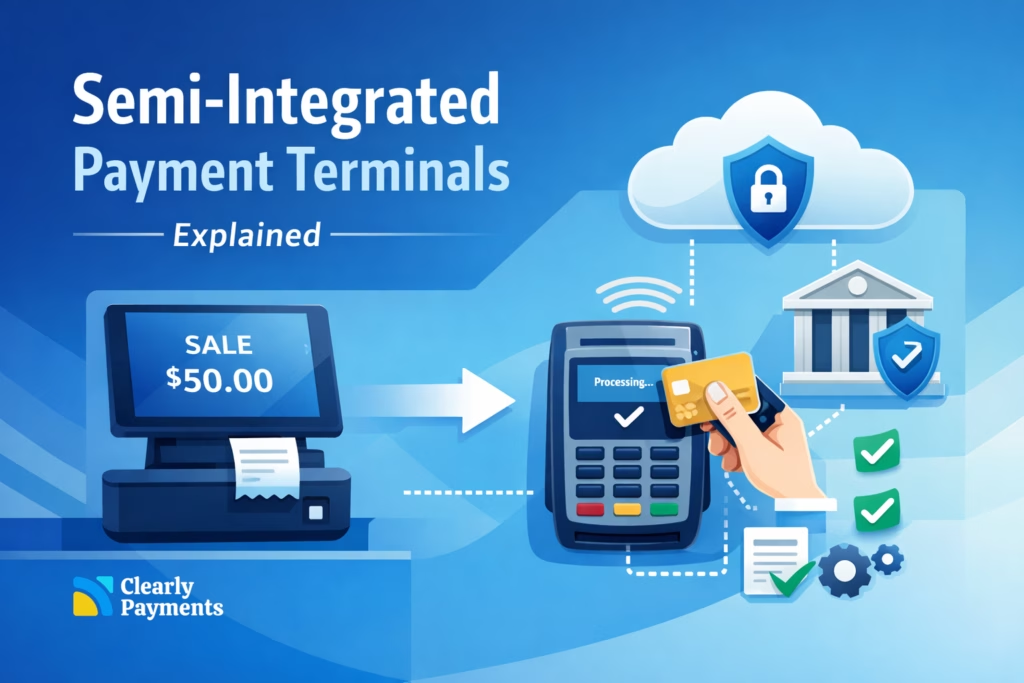
A semi-integrated payment terminal is a card terminal that processes all cardholder data independently from the point-of-sale system.
The POS sends only the transaction amount and basic instructions. The terminal handles the card interaction, encryption, and communication with the processor. The POS never touches card numbers, CVV, or magnetic stripe data.
In practical terms:
- Your POS starts the sale
- The terminal collects the card payment
- The approval result is sent back to the POS
- Sensitive data stays inside the terminal and processor environment
This architecture dramatically reduces security exposure while keeping payments fast and familiar for staff and customers.
Market Adoption and Industries Using Semi-Integrated Terminals
Semi-integrated payment terminals sit within a fast-growing point-of-sale market. The global POS terminal market is projected to reach over US$200 billion by the early 2030s, growing at roughly 8–10 % annually, driven by contactless payments, mobile wallets, and software-led commerce.
Industries where semi-integrated terminals are widely used:
| Industry | Typical Use Cases |
|---|---|
| Retail and franchises | Multi-location checkout, consistent terminal deployments |
| Restaurants and hospitality | High-volume in-person payments, tipping |
| Healthcare and dental | Regulated environments, front-desk payments |
| Service businesses | Salons, auto repair, professional services |
| SaaS and vertical POS | Embedded payments for merchant customers |
Semi-Integrated vs Integrated Payment Terminals
Understanding the difference is helps you plan for both compliance and long-term stability.
| Feature | Integrated Terminal | Semi-Integrated Terminal |
|---|---|---|
| POS handles card data | Yes | No |
| PCI scope | Large | Minimal |
| Breach impact | High | Limited |
| Implementation effort | Heavy | Moderate |
| Ongoing maintenance | Complex | Simpler |
| Best fit | Custom enterprise builds | Most merchants and SaaS |
Integrated terminals require the POS to directly interface with card data flows. This increases PCI requirements, testing, and risk.
Semi-integrated terminals separate responsibilities. The terminal is purpose-built to secure card data, while the POS focuses on sales, inventory, and reporting.
Why Vendors Like Semi-Integrated Terminals
Software vendors and merchants are not switching because semi-integrated terminals are trendy. They are switching because they solve real operational problems.
Reduced PCI Scope: When card data never enters your POS, your PCI obligations drop significantly. This often means fewer controls, less documentation, and lower audit costs.
Lower Breach Risk: If a POS system is compromised, attackers cannot access card numbers because the terminal processes them independently.
Faster Deployment: Semi-integrated setups are quicker to roll out across multiple locations, especially for franchises and growing chains.
Easier Processor Changes: Because the POS is not tightly coupled to a single processor, merchants gain flexibility if pricing or service needs change.
PCI DSS and Liability Considerations
PCI DSS requirements have become more detailed and demanding, especially under newer versions of the standard. Software vendors (SaaS, etc) and merchants using integrated terminals often underestimate the long-term effort required to maintain compliance.
With semi-integrated terminals:
- Card data is isolated to certified devices
- POS systems remain largely out of scope
- Compliance responsibilities are clearer and easier to manage
- The financial and reputational impact of a breach is reduced
This matters not just for enterprise merchants, but also for small and mid-sized businesses that do not have dedicated security teams.
Who Should Use Semi-Integrated Payment Terminals?
Semi-integrated terminals are a strong fit for most in-person payment environments, including:
- Retail stores and franchises
- Healthcare and dental practices
- Hospitality and food service
- SaaS platforms and vertical POS providers
- Any merchant accepting chip, tap, or mobile wallet payments
If your business values security, scalability, and predictable compliance costs, semi-integration is usually the right choice.
How Semi-Integrated Terminals Work With Clearly Payments
Clearly Payments supports semi-integrated terminal architectures designed for modern merchants and software platforms.
With Clearly Payments:
- POS systems send transaction amounts only
- Terminals handle all card data securely
- Merchants benefit from reduced PCI scope
- Deployments scale cleanly across locations
- Canadian and US acquiring is supported
This approach allows merchants to focus on running their business while payments operate reliably in the background.
Common Questions on Semi-Integrated Terminals
Is semi-integrated slower than integrated payments?
No. In most environments, performance is comparable and often more stable because the POS is not responsible for card data handling.
Can I still support tips, refunds, and receipts?
Yes. Semi-integrated terminals support tipping, refunds, voids, and digital or printed receipts.
Does this work with my existing POS?
Most modern POS systems support semi-integrated flows or can add them with minimal development.
Is semi-integration more expensive?
Hardware costs are similar. Many merchants save money long-term through lower compliance and support costs.
Getting Started With Semi-Integrated Terminals
Semi-integrated payment terminals offer a practical balance between usability and security. They reduce risk, simplify compliance, and scale with your business.
Merchants working with Clearly Payments can deploy semi-integrated terminals quickly and confidently, without re-engineering their POS or increasing liability.
If you are evaluating terminal options or planning a POS upgrade, semi-integrated terminals should be your default starting point.
Get a Semi-Integrated Payment Terminal with Clearly Payments
- Wide range of supported industries
- Fast funding
- A full set of payment products to accept payment anytime, anywhere
- World-class customer service