
If you are a merchant doing business in Canada, there is one word you will hear more than any other: Interac.
For U.S.-based businesses expanding north, Interac can be confusing. Is it a bank? A credit card? A tech company? For Canadian businesses, it is simply a way of life.
Understanding Interac is important to reducing costs because it is one of the most cost-effective payment methods available to merchants.
This guide explains what Interac is, how it differs from U.S. debit networks, and why prioritizing it can save your business thousands in processing fees.
What is Interac?
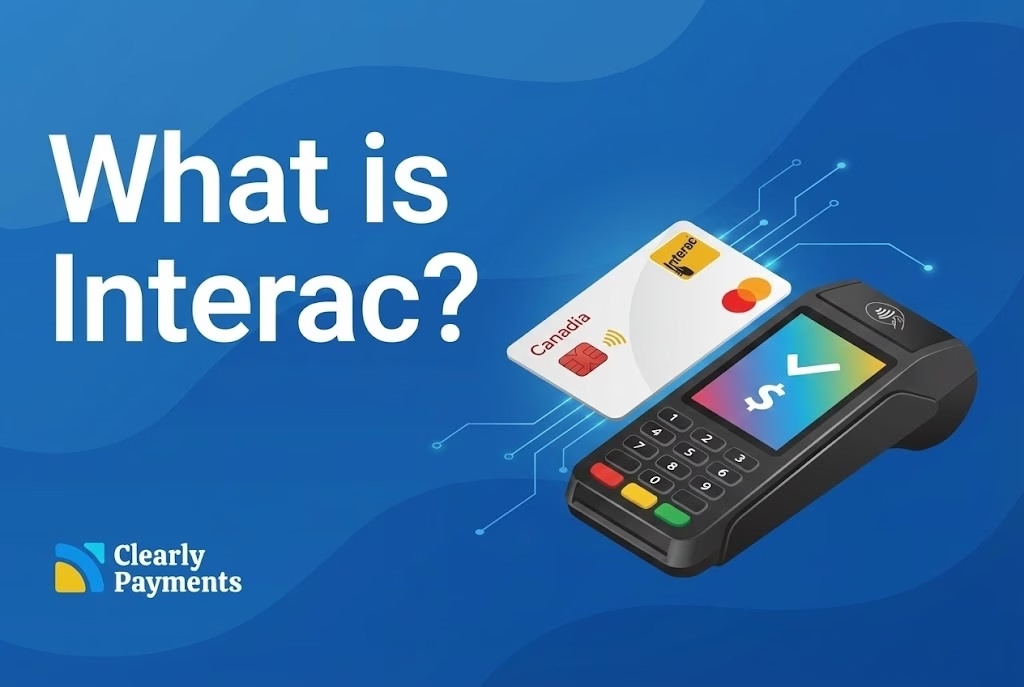
Interac is Canada’s dedicated domestic debit network. It is the national system that allows Canadians to access money directly from their bank accounts to pay for goods and services or send money to others.
Unlike the United States, where debit transactions ride on various networks (like Star, Pulse, or NYCE) or are processed via Visa/Mastercard rails, Canada has a single, unified national debit infrastructure.
- Founded: 1984
- Role: Links all major Canadian financial institutions.
- Reach: Virtually every Canadian with a bank account has an Interac-branded debit card.
When a customer in Canada says, “I’ll pay with debit,” they are paying with Interac.
The 3 Key Interac Services for Merchants
1. Interac Debit (In-Store)
This is the standard “Chip and PIN” or “Tap” transaction at a physical terminal.
- How it works: The customer inserts or taps their card (or mobile wallet like Apple Pay).
- The Benefit: Real-time authorization. The money is withdrawn from the customer’s bank account instantly.
- Security: Extremely high. Because it requires a PIN or biometric authentication on a phone, fraud rates are incredibly low compared to credit cards.
2. Interac e-Transfer (B2B and Invoice Payments)
Originally designed for friends to split dinner bills, Interac e-Transfer has evolved into a powerhouse for business.
How it works: You send an invoice or request money via email/SMS. The customer clicks a link and pays directly from their online banking.
Business Use Case: Perfect for B2B merchants, contractors, and service providers who want to avoid the 2.9% fee on credit cards for large invoices.
Autodeposit: Businesses can set up “Autodeposit” so funds land instantly in their account without needing to answer a security question.
3. Interac Online & In-App
For e-commerce, Interac allows customers to pay directly from their bank account through a secure portal or within apps using digital wallets (Apple Pay/Google Pay). This is vital for merchants targeting younger demographics who may not possess a credit card.
Interac vs. The US Debit System: What’s the Difference?
If you are a U.S. merchant used to “Signature Debit” (where a debit card is processed like a Visa/Mastercard), Interac is a different beast.
| Feature | US Debit (Visa/MC Debit) | Canadian Interac Debit |
| Network | Runs on credit card rails (Visa/MC) | Runs on the Interac domestic network |
| Fees | Percentage-based (often 1% – 2%+) | Flat fee (typically pennies per transaction) |
| Chargebacks | Common | Non-existent (Transactions are final) |
| Verification | Signature or PIN | PIN or Biometric only |
The Takeaway: In the US, debit cards often cost merchants nearly as much as credit cards to process. In Canada, Interac is significantly cheaper.
Why Merchants Like Interac (The Financials)
The biggest reason Clearly Payments advises merchants to encourage Interac payments is cost. When a customer pays with a premium rewards credit card (like a Visa Infinite), you (the merchant) pay a percentage fee that funds those airline points. This can range from 1.5% to 3.5%.
When a customer pays with Interac Debit:
- Flat Fee Structure: You typically pay a small flat fee per transaction (e.g., $0.05 to $0.15 depending on your processor), regardless of the sale amount.
- High Ticket Savings: On a $1,000 sale, a credit card might cost you $25 in fees. An Interac transaction might cost you $0.10.
Note: Pricing depends on your specific merchant agreement, but the “Interac advantage” remains consistent across the industry.
Can US Merchants Accept Interac?
This is a common question.
1. Physical Locations in the US: Yes, many US payment terminals can accept Canadian debit cards. Interac partners with the NYCE network in the US. If a Canadian tourist shops at your store in New York or Florida, they can often use their card, and the transaction is routed via NYCE.
2. Online (E-commerce): It is more complex. To accept Interac Online or e-Transfer strictly, you generally need a Canadian banking relationship or a payment processor (like Clearly Payments) that bridges the gap.
How Clearly Payments Helps
At Clearly Payments, we specialize in helping merchants navigating the cross-border landscape between Canada and the USA.
For Canadian Merchants: We ensure your terminals are set up to prioritize Interac, saving you significant fees on every debit transaction. We also help you implement Interac e-Transfer for high-ticket B2B billing.
For US Merchants: We can help you understand the best way to accept payments from Canadian customers without getting hit with excessive cross-border or currency conversion fees.
Interac is more than just a payment card; it is the backbone of the Canadian economy. Leveraging it correctly is the easiest way to instantly improve your profit margins.
Accept Interact now with Clearly Payments
- Wide range of supported industries
- Fast funding
- A full set of payment products to accept payment anytime, anywhere
- World-class customer service