
Credit Card Processing Pricing: The Ultimate Guide
Compare flat-rate, interchange-plus, membership and tiered pricing. Clearly Payments explains the costs, break-even points and best models by volume and industry.
Payment processing fees are one of the most overlooked expenses for businesses. For many retail, restaurant, and service merchants operating on thin margins, a small change in card mix or pricing model can swing thousands of dollars per year.
Across North America, the typical blended cost to accept a card payment in 2025 ranged from 1.5 percent to 3.0 percent, depending heavily on card brand, card present versus online, and pricing structure. In Canada, new fee reductions introduced by the federal government pushed average domestic consumer credit interchange down to 0.95 percent for eligible small merchants, helping lower overall costs.
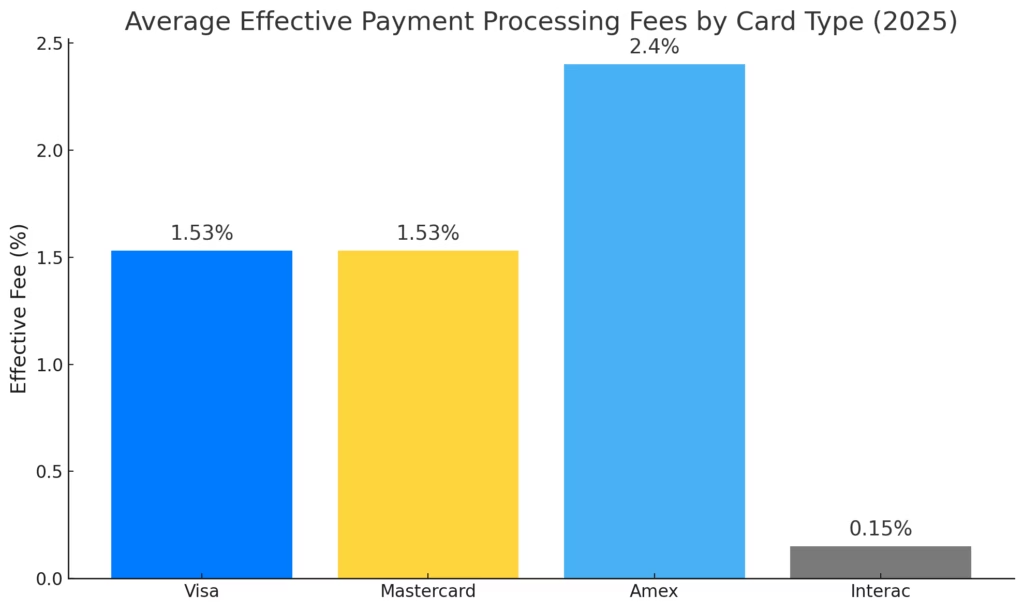
Even with these improvements, merchants continue to see meaningful differences by card type:
This report breaks down what those numbers look like in 2025 and how merchants can benchmark their statements.
Every card transaction contains three cost layers that together form your final effective rate:
Interchange: Paid to the issuing bank. For small Canadian merchants, domestic Visa and Mastercard consumer interchange for in-person transactions now averages 0.95 percent under the federal small business program.
Network Assessments: Small additional fees charged by the networks themselves. These usually land in the range of 0.08 percent to 0.10 percent, plus a few cents per transaction, depending on the brand.
Processor Markup: Your payment processor’s margin. Competitive interchange plus pricing in Canada usually looks like interchange plus 0.15% to 0.70% plus a $0.05 to $0.15 per transaction. A common example is interchange plus 0.40% plus 8 cents.
Interac debit is structured differently with flat per transaction fees that are dramatically lower than credit cards.
The following table uses a $100 in-person transaction at a Canadian retail or restaurant business to show typical 2025 benchmarks.
Table 1. Typical Fees For A $100 Transaction In 2025 with a Basic Credit Card
| Card Type | Interchange And Network Layer | Typical Markup | Total Cost of $100 | Effective Rate |
|---|---|---|---|---|
| Visa Consumer Credit | About 1.05% combined (0.95% interchange plus 0.10% assessments) | + 0.40% plus $0.08 | Approximately $1.53 | 1.53% |
| Mastercard Consumer Credit | About 1.05% combined | + 0.40% plus $0.08 | Approximately $1.53 | 1.53% |
| Amex OptBlue (Small Merchant) | Wholesale discount rate is typically 1.6% to 2.0% | + about 0.30% plus $0.10 | Around $2.40 | 2.40% |
| Interac Debit (In Person) | Flat $0.02 to $0.10 per transaction | + up to $0.05 markup | $0.10 to $0.20 | 0.10% to 0.20% |
What Merchants Should Notice
Visa And Mastercard
American Express
Interac Debit
Online transactions carry higher fraud and chargeback risk, resulting in higher interchange and markups.
Table 2. Typical Effective Fee Ranges By Channel In 2025
| Card Type | In Person | E-commerce or Card Not Present |
|---|---|---|
| Visa Consumer Credit | 1.4% to 2.0% | 1.8% to 2.4% |
| Mastercard Consumer Credit | 1.4% to 2.0% | 1.8% to 2.4% |
| Amex Small Merchant | 2.0% to 3.0% | 2.5% to 3.5% |
| Interac Debit | 0.1% to 0.3% effective | Often 0.6% capped or low flat fees depending on the product |
If your numbers exceed these ranges, especially on tiered pricing, it is usually a sign of hidden or bundled fees.
There are several practical levers that merchants can use to bring their effective rate closer to the bottom of the ranges above. Studies of merchant statements show that the average small business loses around $2,400 per year to hidden payment processing fees, and that nine out of ten merchants overpay due to complex pricing.
Compare flat-rate, interchange-plus, membership and tiered pricing. Clearly Payments explains the costs, break-even points and best models by volume and industry.
If your business accepts payments from other businesses, government agencies, or large organizations, you may be paying more in credit card processing fees than…
Spoiler: Processing rates are only one piece of the puzzle. Many businesses choose a payment processor based on a simple comparison: 2.9% + 30¢…