
What Are Level 2 and Level 3 Interchange Programs?
If your business accepts payments from other businesses, government agencies, or large organizations, you may be paying more in credit card processing fees than…

Credit card processing fees can be confusing for many businesses. Understanding how to calculate your true processing rate is key to managing your costs and finding the right payments partner.
At Clearly Payments, we’re all about transparency. Here’s a straightforward way to calculate your effective credit card processing rate — and what it means for your bottom line.
Your effective rate is the total amount you paid in fees divided by your total credit card sales over a period of time. This gives you a clear percentage that reflects your actual cost of processing payments.
Effective Rate = (Total Fees / Total Credit Card Sales) x 100
Let’s break that down with a simple example:
Total Fees: $300
Total Credit Card Sales: $10,000
Effective Rate = (300 / 10,000) x 100 = 3.0%
That means you’re paying 3% of your credit card sales in processing fees. In general, you should be paying between 2% and 3% for payment processing. However, we have seen many businesses pay 5% or even more.
Your total processing fees are made up of several components — and not all of them go to your payment processor. Here’s what’s typically included. However, this is a simplified version and you can see a larger description of overall payment processor fees here.
These go directly to the customer’s bank (the card-issuing bank).
Rates vary by card type (e.g., basic debit vs. premium rewards credit cards).
Set by the card networks (Visa, Mastercard, etc.) and non-negotiable.
Also known as assessment fees, these are charged by Visa, Mastercard, American Express, and Discover.
Usually a small percentage (e.g., 0.13%) on top of the interchange.
Also non-negotiable.
This is the fee charged by your payment processor for providing the service.
It’s the only negotiable part of the total fee structure.
Can be charged as a flat rate, interchange plus, or in a tiered model.
Each component affects your overall cost. While you can’t change interchange or card brand fees, you can shop around for a better processor markup — and that’s where the biggest savings usually come from.
Knowing your effective rate isn’t just about math — it’s about understanding what you’re actually paying and staying in control of your costs.
Here’s why it’s important:
Spot Hidden or Creeping Fees: It’s common practice in the payments industry for processors to gradually increase rates over time without notice. If you’re not tracking your effective rate regularly, you might not notice small increases that add up.
Make Apples-to-Apples Comparisons: Different pricing models (like flat rate vs. interchange plus) make it hard to compare providers. Your effective rate levels the playing field.
Protect Your Margins: Payment processing is often one of the largest line items for small and mid-sized businesses. Even a 0.5% difference in rates can mean thousands of dollars a year.
Negotiate or Switch When Needed: If your rate creeps up or seems out of line with your sales mix, it might be time to ask your provider for better terms — or switch altogether.
Staying informed helps you keep more of what you earn. And if something doesn’t look right, Clearly Payments is always happy to take a look at your statement and explain what’s going on — no strings attached.
When you accept credit cards, the processing fees are typically deducted automatically, but how and when that happens depends on your billing setup.
There are two main methods: Gross Billing and Net Billing.
You receive the full amount of each sale in your bank account.
All processing fees are collected at the end of the month in one lump sum.
Makes accounting and reconciliation easier since deposits match your sales.
Common for businesses that want clean reporting.
Fees are deducted from each transaction before the money is deposited.
You get a lower daily deposit because it’s already reduced by the fees.
Can make reconciling daily sales to deposits a bit more complex.
Both approaches are legitimate, but gross billing gives you cleaner sales reporting, which is why many merchants prefer it. It also makes calculating your effective rate more straightforward.
If you’re unsure which model you’re on, reviewing your merchant statement or daily deposit reports will usually tell you.
Clearly Payments can review your processing setup, pricing or payment technology.
Talk to Clearly →
If your business accepts payments from other businesses, government agencies, or large organizations, you may be paying more in credit card processing fees than…
Spoiler: Processing rates are only one piece of the puzzle. Many businesses choose a payment processor based on a simple comparison: 2.9% + 30¢…
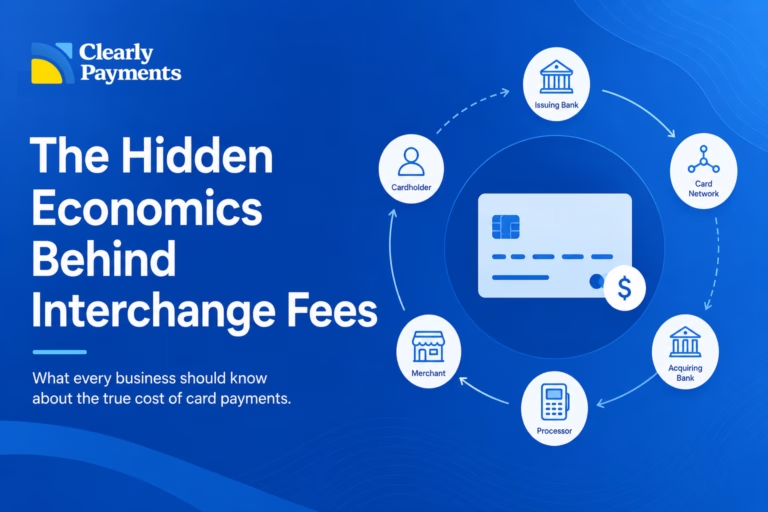
When a customer taps, inserts, or enters a credit card online, the transaction appears almost instantaneous. A receipt is generated, funds begin moving, and…