
What Are Level 2 and Level 3 Interchange Programs?
If your business accepts payments from other businesses, government agencies, or large organizations, you may be paying more in credit card processing fees than…

Credit card processing fees are a cost of doing business, but that doesn’t mean you can’t reduce them. In 2025, the average business pays between 1.5% to 3.5% per transaction in credit card fees, depending on their industry, sales volume, risk profile, and the type of cards accepted (e.g., Visa, Mastercard, AMEX).
For many merchants, payment processing is one of the top five operating expenses. In 2025, the top five operating expenses for most businesses are payroll, rent, payment processing fees, inventory or cost of goods sold, and marketing. Here’s what you need to know about where those fees come from and how to start saving money on every transaction.Every time a customer pays with a credit card, the transaction passes through a series of parties—each taking a cut:
Interchange Fees: Set by the card networks (Visa, Mastercard, etc.), interchange fees go to the customer’s issuing bank.
Assessment Fees: Paid to the card networks themselves.
Processor Markup: What your payment processor charges for providing the service.
While you can’t control interchange or assessment fees (they’re standardized across the industry), you can control the markup, which is often the most negotiable piece of the puzzle.
| Card Type | Average Fee Range |
|---|---|
| Visa / Mastercard | 1.5% – 2.5% |
| AMEX | 2.3% – 3.5% |
| Online/Keyed-In | 2.0% – 3.5% |
| In-Person (Chip/Tap) | 1.5% – 2.9% |
Note: Businesses in higher-risk or high-ticket industries (like travel or furniture) may see higher averages.
If you’ve ever signed up with Stripe, Square, or PayPal, you’re likely on a flat-rate pricing model. These companies act as payment aggregators, grouping many merchants under one large merchant account. It’s fast and convenient to get started—but it often comes at a cost.
You’re charged a fixed rate (e.g. 2.9% + 30¢) on every transaction—regardless of card type, transaction method, or risk profile.
Simple to understand, but you often overpay on lower-cost transactions (like debit or tap payments).
There’s limited room for negotiation and less pricing transparency.
You pay the actual interchange fee (set by Visa/Mastercard) plus a small, transparent markup from your processor.
Costs are aligned with the true risk and cost of each transaction—so you save money on lower-risk payments (like in-person debit).
It’s more customizable and scales better as your business grows.
| Pricing Model | Pros | Cons |
|---|---|---|
| Flat-Rate (Aggregator) | Simple to understand Easy setup | Often more expensive Harder to scale |
| Interchange-Plus | Transparent pricing Lower total cost | Slightly more complex May require setup support |
Bottom line:
Flat-rate pricing is convenient for small, new businesses, but once your volume increases—or if you’re doing more in-person sales—interchange-plus can save you thousands per year. Processors like Clearly Payments make interchange-plus simple and accessible, without the confusion or high fees.
Interchange-plus pricing is the most transparent pricing model. It separates the non-negotiable interchange fees from your processor’s markup, so you can see exactly what you’re being charged and where you can save.
Many businesses overpay because they’re with a legacy processor or bundled into their bank’s payment services. Switching to a low-cost, transparent provider like Clearly Payments can significantly reduce your processing costs. Some merchants save up to 40% by switching.
In-person transactions (with chip or tap) are less risky and therefore cheaper than keyed-in or online payments. If possible, encourage customers to pay using terminals rather than manually entering card details.
Chargebacks not only result in lost revenue—they often come with additional fees. Use clear billing descriptors, responsive customer service, and fraud detection tools to reduce chargebacks.
Your Merchant Category Code (MCC) affects your rates. If your code doesn’t accurately reflect your business type—or if you’ve changed business models—updating it could improve your rates.
Some processors lock businesses into long-term terminal leases with hidden fees. If possible, buy your hardware upfront or use a processor like Clearly Payments that offers low-cost terminals without long-term contracts.
Processors can (and sometimes do) increase rates or add hidden fees over time. Reviewing your monthly statements can catch these changes early and help you spot areas for savings.
Clearly Payments was built to fix a broken system. Unlike many processors that hide fees in complex pricing models, we believe in transparency and fairness. Here’s what sets us apart:
Interchange-plus pricing with zero hidden fees
No locked-in contracts or cancellation fees
Lower rates across industries
Next-day deposits to keep your cash flowing
Real people to support your business—not just support tickets
Whether you’re a startup, retail store, restaurant, or large enterprise, we’ll help you cut costs without sacrificing service or security.
If your business accepts payments from other businesses, government agencies, or large organizations, you may be paying more in credit card processing fees than…
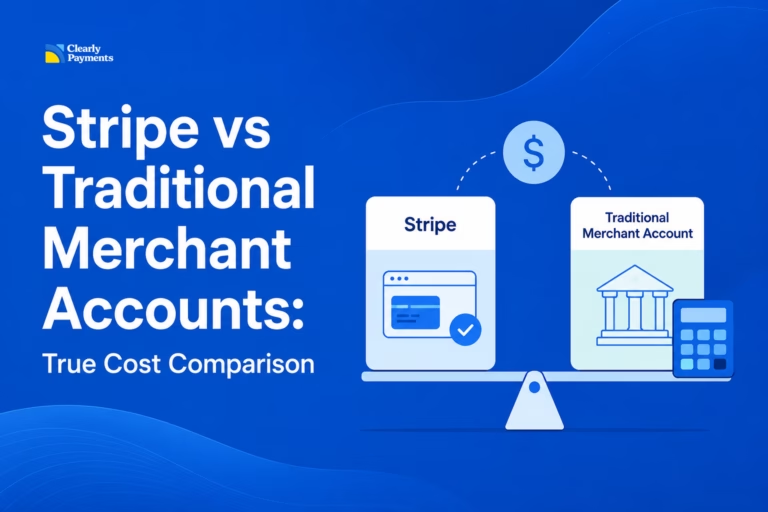
Spoiler: Processing rates are only one piece of the puzzle. Many businesses choose a payment processor based on a simple comparison: 2.9% + 30¢…
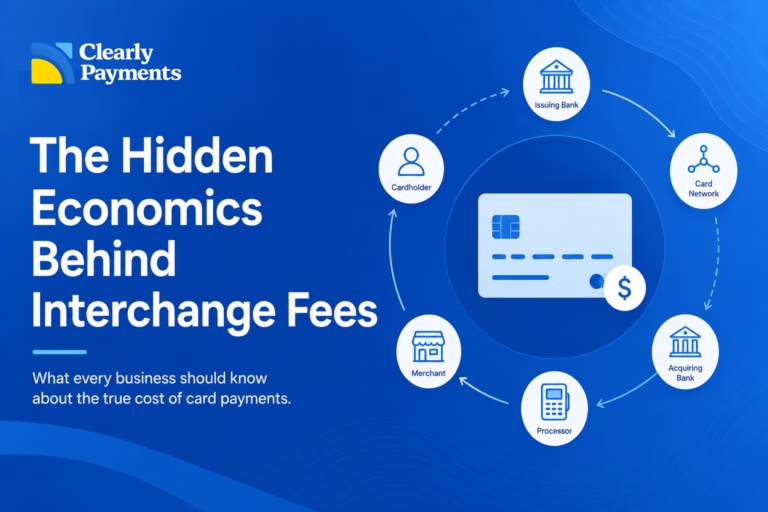
When a customer taps, inserts, or enters a credit card online, the transaction appears almost instantaneous. A receipt is generated, funds begin moving, and…