
The payments industry has changed dramatically over the last decade. Businesses can now start accepting payments in minutes, software platforms are embedding financial services directly into their products, and merchants increasingly expect seamless onboarding with minimal paperwork. This shift has brought significant attention to two common payments models: the traditional ISO model and the newer Payment Facilitator, or PayFac, model.
While both models allow businesses to process credit card and digital payments, they operate very differently behind the scenes. The structure impacts merchant onboarding, compliance obligations, underwriting requirements, risk management, user experience, and even revenue opportunities. Understanding the differences is important for SaaS platforms, marketplaces, ecommerce companies, and merchants evaluating payment partnerships.
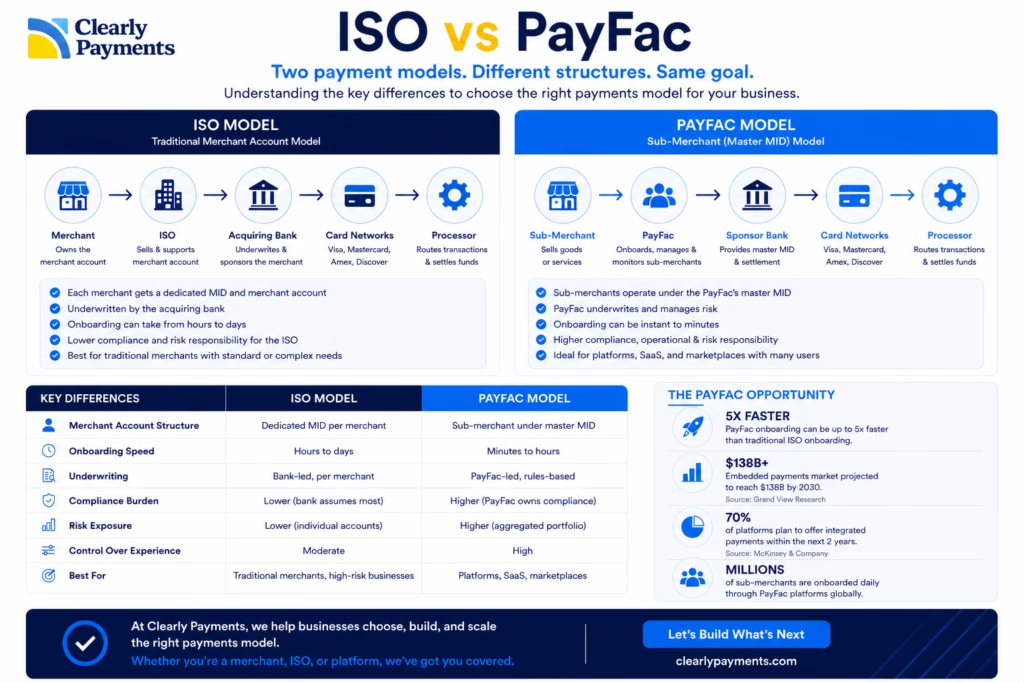
What Is an ISO?
A typical ISO structure looks like this:
| Participant | Role |
|---|---|
| Merchant | Accepts payments |
| ISO | Sells and supports merchant accounts |
| Acquiring Bank | Sponsors and underwrites merchants |
| Card Networks | Visa, Mastercard, American Express, Discover |
| Processor/Gateway | Handles transaction routing and settlement |
What Is a Payment Facilitator (PayFac)?
A Payment Facilitator, commonly called a PayFac, simplifies the onboarding process by allowing merchants to operate as sub-merchants under a master merchant account owned by the PayFac itself.
Instead of every merchant receiving an individual merchant account directly from the acquiring bank, the PayFac aggregates many merchants under its own infrastructure. The PayFac takes responsibility for underwriting, compliance monitoring, fraud management, Know Your Customer (KYC) requirements, and transaction oversight.
This model became significantly more popular with the growth of embedded payments and platforms such as Stripe and Square. It allowed software companies and marketplaces to activate payment acceptance almost instantly within their own applications.
Visa introduced its modern Payment Facilitator framework in the mid-2010s as ecommerce and SaaS adoption accelerated. Today, the PayFac model is widely used by vertical SaaS companies, marketplaces, creator platforms, gig economy applications, and embedded finance providers.
One of the biggest advantages of the PayFac model is onboarding speed. Some PayFacs can approve merchants in minutes using automated underwriting systems and real-time identity verification tools.
ISO vs PayFac Comparison
| Feature | ISO Model | PayFac Model |
|---|---|---|
| Merchant Account Structure | Dedicated MID per merchant | Sub-merchants under master MID |
| Merchant Onboarding | Slower | Faster |
| Underwriting | Bank-led | PayFac-led |
| Compliance Burden | Lower | Higher |
| PCI Responsibility | Mostly shared with processor/acquirer | Greater PayFac responsibility |
| Risk Exposure | Lower | Higher aggregated exposure |
| User Experience Control | Moderate | High |
| Embedded Payments Support | Limited | Excellent |
| Best Fit | Traditional merchants | SaaS and platforms |
| Operational Complexity | Lower | Much higher |
Why the PayFac Model Became Popular
The rapid growth of SaaS and marketplaces created demand for faster and more integrated payment experiences. Software companies realized payments could become both a revenue stream and a retention tool.
Research from McKinsey & Company has shown that embedded finance is becoming one of the fastest-growing areas within financial services, with embedded payments often serving as the first entry point.
For example, a restaurant management platform may want restaurants to activate payments directly inside the software instead of applying separately through an external provider. A marketplace may want sellers onboarded instantly to reduce friction and improve conversion rates.
The PayFac model enables:
- Faster merchant activation
- More seamless onboarding
- Unified user experiences
- Revenue sharing opportunities
- Better data ownership
- Integrated reporting and reconciliation
This has made PayFac structures highly attractive for software platforms seeking to monetize payments.
The Operational Reality of Becoming a PayFac
While the PayFac model offers strategic advantages, many businesses underestimate the operational complexity involved.
Becoming a registered PayFac requires significantly more infrastructure than operating as a traditional ISO. The PayFac assumes responsibility for:
- KYC and KYB verification
- Anti-money laundering monitoring
- Fraud detection
- Chargeback management
- Transaction monitoring
- PCI compliance oversight
- Reserve management
- Sponsor bank relationships
- Card network compliance
Visa and Mastercard maintain strict requirements for PayFac registration and sponsor bank oversight. Businesses often need dedicated compliance teams, fraud systems, underwriting operations, and ongoing monitoring programs.
This is one reason many software companies choose a “PayFac-as-a-Service” model instead of becoming a fully registered PayFac themselves.
The Rise of PayFac-as-a-Service
In recent years, many infrastructure providers have emerged to simplify PayFac deployment. Companies such as Finix, Adyen, Checkout.com, and Stripe Connect provide infrastructure that helps platforms launch embedded payments without building the entire compliance and banking stack themselves.
This hybrid approach allows platforms to:
- Launch faster
- Reduce regulatory burden
- Access sponsor bank infrastructure
- Simplify compliance management
- Focus on product development
The tradeoff is usually reduced flexibility, lower margins, or less operational control compared to running a fully independent PayFac program.
Which Model Is Better?
There is no universal answer because the best model depends on the type of business.
Traditional merchants often benefit from the ISO model because it provides:
- Stable underwriting structures
- Dedicated merchant accounts
- More customized risk management
- Better support for complex or high-risk industries
- Lower operational overhead
Meanwhile, software platforms and marketplaces often prefer the PayFac model because it creates:
- Better onboarding conversion
- Embedded user experiences
- Additional revenue opportunities
- Stronger customer retention
- More ownership of payment data
In many cases, companies start as referral partners or ISOs before eventually transitioning toward a PayFac or PayFac-as-a-Service structure as they scale.
Why Established Businesses Still Choose Dedicated Merchant Accounts
While PayFac models have become extremely popular for SaaS platforms, marketplaces, and embedded payments, many established businesses still prefer traditional merchant accounts through payment providers and ISOs.
With a traditional merchant account, each business receives its own dedicated Merchant ID (MID) and underwriting relationship. This structure can provide greater long-term stability, more customized risk management, and stronger support as a business grows. For companies processing larger volumes, operating internationally, managing recurring billing, or selling in more complex industries, dedicated merchant accounts often offer greater flexibility than aggregated PayFac models.
Traditional merchant accounts can also reduce the likelihood of broad portfolio-level risk actions that sometimes occur within aggregated PayFac environments. Because underwriting is performed directly on the individual business, acquiring banks and processors often have a clearer understanding of the merchant’s operating model, transaction patterns, and risk profile over time.
Many businesses also value having:
- Customized pricing structures
- Direct human support
- More flexible underwriting reviews
- Better support for higher monthly processing volumes
- Greater control over payment configurations
- Long-term account stability as the business scales
This is one reason the traditional merchant account model remains widely used across ecommerce, professional services, retail, healthcare, manufacturing, hospitality, and B2B industries despite the rapid growth of embedded payments and PayFac platforms.
At Clearly Payments, we help Canadian and U.S. businesses access dedicated merchant accounts, ecommerce payment solutions, recurring billing tools, virtual terminals, and tailored payment support designed for long-term growth.
The Future of Embedded Payments
The distinction between ISOs and PayFacs is becoming increasingly important as embedded finance continues to expand. Payments are no longer viewed only as infrastructure. They are increasingly becoming part of the software experience itself.
Industry analysts estimate embedded finance could represent hundreds of billions in revenue globally over the next decade as more platforms integrate payments, lending, banking, and insurance directly into software workflows.
At the same time, regulatory scrutiny and compliance expectations are increasing. Fraud prevention, identity verification, transaction monitoring, and risk management remain critical operational requirements regardless of the model chosen.
For businesses evaluating payment strategies today, the decision is less about which model is “better” and more about which model aligns with their customer experience goals, operational capabilities, and long-term business strategy.
Get a merchant account with Clearly Payments
- Dedicated merchant accounts
- In-person, eCommerce, & recurring billing
- Canadian & U.S. payment processing
- Personalized support for growing businesses