
Best Payment Processing for Contractors (2026 Guide)
Whether you’re an electrician, plumber, HVAC company, roofer, landscaper, painter, home renovator, or general contractor, getting paid quickly matters. Contractors often pay for labour,…
The banking landscape is undergoing a transformation, driven by the emergence of neobanks. These digital-only banks are challenging the traditional financial institutions by offering products and services that cater to the needs of tech-savvy consumers.
In this article, we will explore the growth of neobanks in Canada and the USA, and examine their impact on the payments industry.
Neobanks, also known as challenger banks or fintech banks, are financial institutions that operate exclusively online. They do not have physical branches, and they offer a range of financial products and services, including checking and savings accounts, debit cards, and credit cards. Neobanks are typically known for their user-friendly mobile apps, competitive fees, and innovative features.
For their banking structure, Neobanks can come in two forms. 1) a fully licensed bank that has gone through the rigourous process to become a schedule 1 certified bank. 2) A bank that has created a new user interface that resells services to an exising traditional bank. This means it looks like you have an account with the neobank, but under the covers, money is managed by the traditional bank.
The neobank market is expanding both globally and within Canada and the USA, with solid projected growth rates. Globally, the neobank market is expected to reach a value of $376.34 billion by 2026, growing at a compound annual growth rate (CAGR) of 23.25% (Fintech News).
In Canada, the neobank market is seeing good growth, with the number of users projected to reach 5 million by 2028, representing a user penetration of 12.22%.
Meanwhile, in the USA, the neobank user base is forecasted to reach 80 million by 2025, accounting for a penetration rate of 24%. This growth is fueled by the preference of 72% of US millennials and Gen Z to primarily bank online (Cornerstone Advisors).
In terms of the traditional banking landscape, Canada has 28 domestic banks, while the United States boasts over 7,000 banks. The core difference is that the Canadian banks have a larger share of loans. This scale is one of the main factors that makes them somewhat safer than American banks. Other than that, the Canadian financial system and the American financial system are quite similar.
The top 5 banks in Canada hold roughly 90% market share, including TD Bank, Royal Bank of Canada, Bank of Nova Scotia, Bank of Montreal, and CIBC. In contrast, the top 5 banks in the USA hold 53% market share, including JP Morgan, Bank of America, Citibank, Wells Fargo, and US National Bank Association.
One advantage of neobanks lies in their impressive user engagement metrics. Notably, the average neobank garners a significantly higher level of daily active users, with an average of 1,400 compared to traditional bank branches which see only 577 visits per day (Mercator Advisory Group). This disparity highlights the appeal of neobanks’ digital-first approach, offering customers convenient and accessible banking services that encourage frequent interactions and sustained engagement.
Popular neobanks in the USA include Chime, Varo, Aspiration, and Current, while in Canada, Koho, Mogo, Stack, Wingocard, and Neo Financial are among the larger neobanks.
Despite the neobank growth, most traditional banks likely do not think that neobanks pose a significant competitive threat. This is partly due to their relatively low market share and reliance on established financial institutions for products and infrastructure, limiting their unique technological advantages. Additionally, neobanks face competition from major banks transitioning to digital platforms and are hindered by incomplete Open Banking regulations.
This growth is being driven by a number of factors, including:
Neobanks are poised to change the payments landscape in several ways. Firstly, their digital-first approach and streamlined user experiences enable seamless and efficient payment processes. By leveraging technology, neobanks can offer faster and more convenient payment options, reducing the reliance on traditional payment methods such as cash and checks.
Neobanks are driving the adoption of contactless and mobile payment solutions, aligning with changing consumer preferences for quick and secure transactions. With features like tap-to-pay and integration with digital wallets like Apple Pay and Google Pay, neobanks are facilitating frictionless payment experiences, especially in retail and e-commerce settings.
Additionally, neobanks are pioneering the development of personalized and data-driven payment solutions. By harnessing customer data and analytics, neobanks can offer tailored payment recommendations, budgeting tools, and rewards programs, enhancing the overall payment experience for users.
Furthermore, neobanks are challenging traditional banking fee structures by offering low or no-fee payment options, attracting cost-conscious consumers seeking affordable banking solutions. This disruption of pricing models has the potential to drive competition and innovation in the broader payments industry.
Despite their growth, neobanks face a number of challenges, including:
However, neobanks also have a number of opportunities, such as:
The trajectory of neobanks suggests a future of sustained growth and disruption within the traditional banking industry. Positioned as agile and innovative alternatives, neobanks have been steadily gaining traction among consumers seeking digital-first banking experiences. As they mature and establish credibility, neobanks are poised to assume a more significant role in the broader payments ecosystem.
While the current growth trajectory is promising, there is a looming concern that neobanks may eventually evolve into mere replicas of traditional banks. This potential convergence raises questions about the long-term sustainability of their disruptive edge. To avoid this fate and continue thriving, neobanks must prioritize innovation and differentiation.
One crucial aspect for the continued growth of neobanks is their ability to launch new services rapidly, offering ease of use compared to traditional banking counterparts. The hallmark of neobanks has been their seamless digital interfaces, simplified account management, and quick access to financial services. This convenience factor has been instrumental in attracting tech-savvy consumers who prioritize efficiency and convenience in their banking experiences.
Furthermore, neobanks need to excel in providing superior customer support, setting a higher standard than traditional banks in this aspect. With a focus on personalized and responsive assistance, neobanks can foster stronger relationships with their customer base, enhancing trust and loyalty. By leveraging advanced technologies such as artificial intelligence and chatbots, neobanks can offer round-the-clock support and address customer queries and concerns in real-time, distinguishing themselves from their more traditional counterparts.
Additionally, the future growth of neobanks hinges on traditional banks being complacent. If traditional banks fail to innovate and adapt to changing consumer preferences, they risk losing market share to neobanks. Neobanks, with their agility and customer-centric approach, are well-positioned to capitalize on any gaps left by traditional banks in meeting evolving consumer needs. However, this dependency on traditional banks’ stagnation underscores the importance of neobanks continually pushing the boundaries of innovation and service excellence.
Clearly Payments can review your processing setup, pricing or payment technology.
Talk to Clearly →
Whether you’re an electrician, plumber, HVAC company, roofer, landscaper, painter, home renovator, or general contractor, getting paid quickly matters. Contractors often pay for labour,…
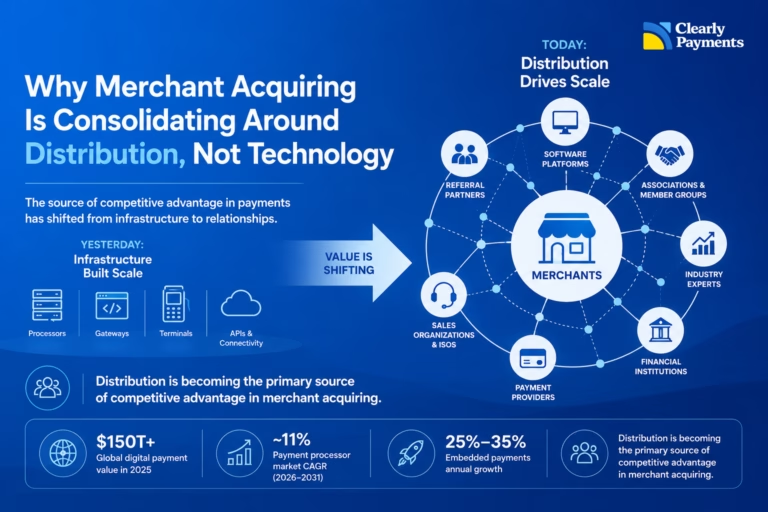
The payments industry has spent decades investing in technology. Processors built massive infrastructure platforms. Acquirers invested billions in connectivity, security, compliance, hardware certifications, and…
Accepting credit cards is essential for most businesses today, but the fees can quietly add up. Many merchants assume payment processing rates are fixed,…