
How Long Do Credit Card Payments Take to Settle?
Credit card payments typically take 1–3 business days to settle, although some transactions can settle as quickly as the next business day. The exact…
When your business accepts credit or debit cards, adhering to the PCI DSS (“Payment Card Industry Data Security Standard”) is non-negotiable. Failure to validate compliance with PCI DSS often triggers what are known as PCI non-compliance fees, recurring charges imposed by acquirers or processors until the merchant resolves the compliance gap.
This article explains what PCI non-compliance fees are, how they are calculated, why processors charge them, and most importantly, how merchants can avoid paying them in the first place.
PCI non-compliance fees are penalties levied when a merchant fails to demonstrate compliance with PCI DSS requirements. They differ from standard “compliance fees” (which cover tools/services to help you stay compliant) and are, in essence, the “cost of doing nothing” (or insufficient action) when compliance documentation, scanning, or controls are missing or outdated.
Key characteristics:
PCI non-compliance fees are basically a risk-management tool by acquirers:
For a merchant, the message is simple: invest a modest effort to validate compliance rather than accumulate fees and increase breach risk.
Payment processors and card networks continue to tighten security standards, and failing to meet PCI DSS requirements can be expensive. In 2025, non-compliance fees are typically charged monthly and can range from $20 to over $100 per month, depending on your processor, business type, and transaction volume. For larger or high-risk merchants, those costs can escalate quickly, sometimes reaching thousands of dollars annually.
Typical monthly non-compliance fee levels for small/mid-sized merchants
Larger merchant/higher risk exposure
Compliance cost vs non-compliance fee
It helps to understand the typical root causes. They are standard gaps in the compliance lifecycle.
Clear steps to avoid the fees and focus on proactive compliance:
Identify your merchant level and required SAQ type
Determine which SAQ applies (SAQ A, B, C, D, etc) based on how you accept cards (e-commerce, retail terminal, card-on-file etc).
Use the portal your acquirer provides or manage your SAQ submission annually.
On 31 March 2024, the standard PCI DSS v3.2.1 will retire and transition to PCI DSS v4.0.
Schedule and complete quarterly vulnerability scans (if required)
Make the scans recurring in your calendar or with an ASV vendor.
Review results, fix issues, and upload evidence to your acquirer or portal.
Use secure, PCI-validated payment infrastructures
Tokenization, hosted payment pages, point-to-point encryption (P2PE) reduce your scope and risk.
Modern systems typically make compliance simpler, which reduces the chances of a non-compliance flag.
For example, use a reader/terminal certified for PCI PTS or a gateway marked for PCI-Level compliance.
Maintain documentation and audit trail
Save your SAQ completion, scan reports, AOCs, and remediation logs.
If your acquirer flags non-compliance, having documentation can often stop or reverse fees.
Monitor your merchant statement for “PCI non-compliance fee” line items
Don’t ignore them. If you see a charge labelled “PCI non-compliance fee”, contact your processor immediately and ask:
“What condition triggered this fee, and what proof do you need for my account to be flagged compliant?”
Once you’ve filled the gap, ask that the acquirer credits or stops the fee going forward.
From a commercial perspective the numbers speak clearly:
For merchants working with Clearly Payments, we recommend embedding PCI compliance into your payment-operations baseline:
Credit card payments typically take 1–3 business days to settle, although some transactions can settle as quickly as the next business day. The exact…
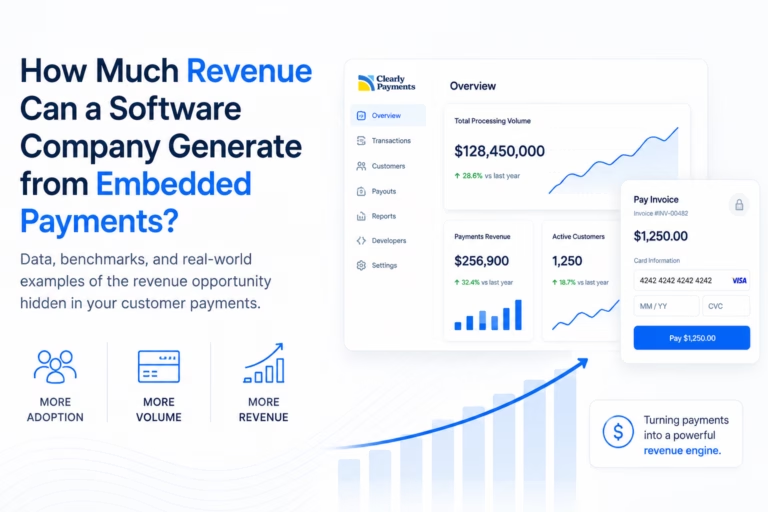
For many software companies, subscription (SaaS) revenue has traditionally been the primary business model. Customers pay a monthly or annual fee to access the…
Artificial intelligence is rapidly evolving from a passive assistant into an active participant in the economy. Today, AI systems summarize documents, answer questions, generate…