
The Cost of Running Payments at Scale: Staffing, Operations & Transaction Costs
Understand payment operations costs, staffing, reconciliation and automation savings, with worked examples for building a payment-operations budget.

If your business accepts credit cards, chargebacks are a part of doing business. Chargebacks can impact your business’s revenue, reputation, and customer relationships. With rising fraud and online shopping, efficiently managing a chargeback team can be a big differentiator for your business.
This guide provides an overall approach to managing a chargeback team, covering everything from key roles and responsibilities to leveraging technology, monitoring performance, and incorporating data-driven strategies.
A chargeback is a reversal of a credit card transaction initiated by the cardholder’s bank, usually as a result of a dispute by the customer over the purchase. It acts as a consumer protection tool, allowing customers to reclaim funds for unauthorized transactions, fraud, or dissatisfaction with goods or services.
Here are some other resources on chargebacks:
A chargeback occurs when a customer disputes a charge with their card issuer, leading to the reversal of a payment. While chargebacks were originally introduced as a consumer protection tool, they are frequently used in cases of fraud or simply as a means of securing a refund quickly (friendly fraud). A well-organized chargeback team minimizes these risks and protects the merchant’s bottom line.
To manage chargebacks effectively, you’ll want to create a team that includes poeple skilled in finance, customer service, and fraud prevention. The following roles are the most common in a chargeback team:
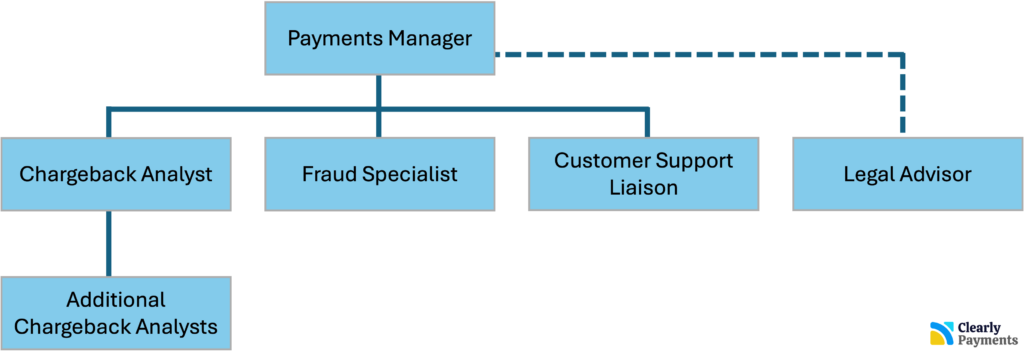
Managing a chargeback team requires coordination between specialized roles to minimize disputes and protect revenue. Each team member has a specific function, but their effectiveness comes from how well they collaborate.
The chargeback analyst reviews dispute notices and collects evidence to fight chargebacks. They work with various departments to gather data:
The fraud specialist identifies fraudulent transactions to reduce chargebacks.
Customer service is often the first point of contact for resolving customer issues before they escalate into chargebacks.
In complex or high-value disputes, the legal advisor ensures compliance with regulations and assists in developing a robust defense during the representment process.
Automated chargeback management platforms streamline processes, helping teams manage cases, track deadlines, and quickly file representments.
Managing a chargeback team requires a combination of good planning, efficient processes, and continuous improvement. Implementing best practices helps your team operate effectively, reducing chargebacks and safeguarding revenue. Here are key strategies to help your chargeback team succeed.
Automating your chargeback management process greatly increases efficiency. Today’s merchants can utilize chargeback management software platforms that streamline data collection, track deadlines, and organize communication between departments.
Some chargeback management tools use machine learning and AI to detect patterns in fraudulent transactions, identify friendly fraud, and even automate the submission of evidence to issuing banks.
Key Statistic: According to a study by Juniper Research, the cost of online payment fraud is expected to exceed $48 billion by 2023. Leveraging automation and AI can reduce the manual workload on your chargeback team by up to 30%.
Successful chargeback management relies heavily on internal and external communication. Internally, it’s important that your customer service, accounting, and chargeback teams work together seamlessly. Customers are more likely to file chargebacks if their issues aren’t addressed quickly through customer service.
Externally, communication with acquiring banks, payment processors, and customers should be handled with precision and professionalism. Responding to chargeback notifications promptly, gathering required documents on time, and submitting evidence without delay is essential.
Key Statistic: Around 86% of chargebacks are the result of customer service issues that could have been avoided with better communication.
Establishing key performance indicators (KPIs) helps measure the effectiveness of your chargeback team. Some KPIs to track include:
Key Statistic: Merchants who manage their chargeback processes efficiently and respond within the allotted timeframe have a 60% higher chance of winning disputes.
Preventing chargebacks is the most effective way to reduce their financial and operational burden. A well-rounded prevention strategy should include:
Key Statistic: Chargeback fraud accounts for 70% of the $48 billion in losses merchants are projected to incur due to online payment fraud.
Clearly Payments can review your processing setup, pricing or payment technology.
Talk to Clearly →
Understand payment operations costs, staffing, reconciliation and automation savings, with worked examples for building a payment-operations budget.

Credit card payments typically take 1–3 business days to settle, although some transactions can settle as quickly as the next business day. The exact…

For many software companies, subscription (SaaS) revenue has traditionally been the primary business model. Customers pay a monthly or annual fee to access the…